
As ski resorts look for ways to reduce their environmental impact, re-using existing lift infrastructure is becoming an increasingly attractive alternative to building new installations from scratch.
Known as réemploi in France, the practice involves dismantling ski lifts that are no longer required at one resort and giving their components a second life elsewhere.
It can reduce the demand for raw materials, cut manufacturing emissions and, in some cases, significantly lower the cost of upgrading mountain infrastructure.
Re-using lifts in practice
At Val Cenis, the new six-seater detachable Grand Coin chairlift has been assembled using equipment dismantled from Saint-Pierre-de-Chartreuse. According to the resort, reusing the installation required ten times fewer materials and generated half the greenhouse gas emissions of constructing an entirely new lift.
There are also financial benefits. At Les Carroz, the Gron chairlift is being replaced by a six-seater detachable lift sourced from the Pyrenees, where it was originally due to be dismantled. The resort estimates that reusing the equipment has saved almost 30% of the overall project budget.
Other resorts are also finding opportunities to extend the working lives of existing installations.
At Les Gets, the Grains d’Or chairlift was dismantled and subsequently reinstalled in the Mont Chéry sector. The lift had become surplus to requirements following a reorganisation of the ski area.
At Praz-de-Lys Sommand, a four-seater chairlift previously operating at La Plagne is being used to replace the Brésy drag lift.
Meanwhile, at Les 2 Alpes, the Champamé drag lift is being reconstructed using some components sourced from Les Orres.
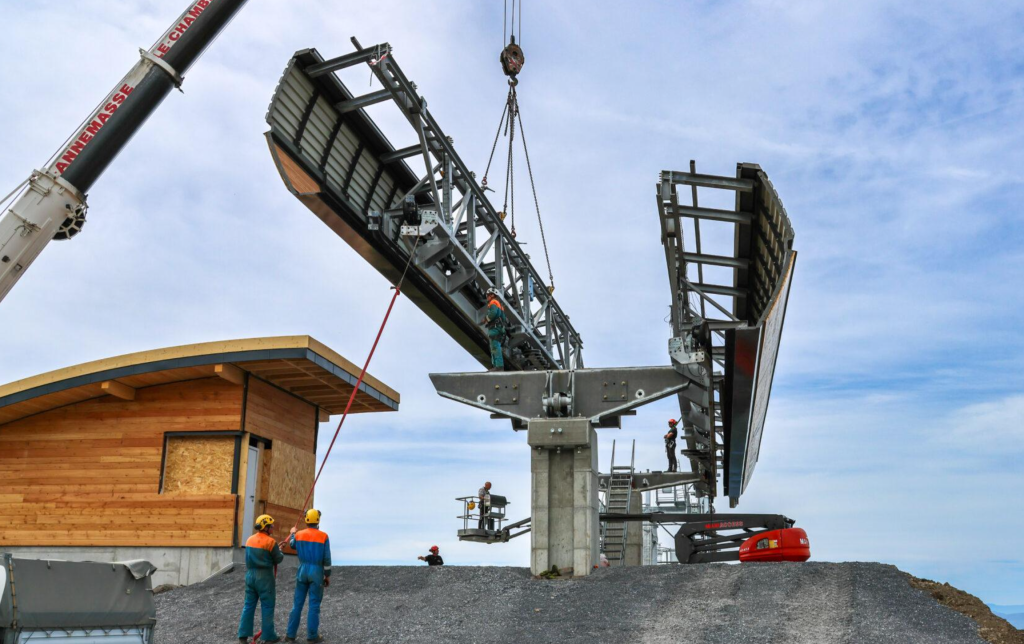
The Gron lift in Les Carroz
A circular economy for ski resorts
The examples highlight how the ski industry can apply circular economy principles to one of its most resource-intensive areas of infrastructure.
Ski lift construction requires substantial quantities of steel, concrete, electrical equipment and other materials.
Manufacturing and transporting these components also carries an environmental cost, particularly when new installations are required in remote mountain locations.
Reusing existing equipment offers a way to reduce some of that impact while making better use of infrastructure that might otherwise be scrapped.
For an industry facing the combined challenges of climate change, rising construction costs and pressure to reduce its environmental footprint, building less and reusing more makes considerable sense.
As The Ski Podcast’s Equipment Expert, Al Morgan always says, “The most sustainable item is the one you already own”. In this case, for a ski resort, the most sustainable ski lift may not always be a new one.


